

MD&A · 2025
In this section4 topics
Overview of Operations
Overview of Operations
The Company and its subsidiaries primarily operate as turnkey contractors for building engineering systems ( Turnkey M&E Contractor) by providing services in Mechanical and Electrical Engineering Systems (M&E) for various types of building projects, such as residential buildings, office buildings, data centers (Data Center) and commercial projects
In the year 2025, The Company and its subsidiaries operate under challenging economic conditions, stemming from low economic growth, political uncertainties both domestically and internationally, as well as natural disasters resulting in a slowdown in the growth of the construction industry and a relatively high competitive environment. The company has set business strategies focusing on sustainable growth and long-term strength through 5 Key approaches include:
1. Expanding customer base and new markets
2. Operational Efficiency Enhancement for Sustainable Growth
3. Building long-term relationships with stakeholders
4. Promoting a safety culture at work
5. Maintaining financial strength
The Company and its subsidiaries continue to achieve consistent growth in performance. In the year 2025 with primary revenue from providing integrated engineering systems services totaling 805.60 million Baht and net profit of 72.26 million Baht, growing by a percentage from the previous year 28.37 and percentage 54.96 respectively.
Operating Results & Financial Condition
Operating Results & Profitability
Analysis of operating results
Statement of comprehensive income | Year 2023 | Year 2024 | Year 2025 | Change 2024 - 2023 |
| ||
million Baht | million Baht | million Baht | million Baht | % | million Baht | % | |
Revenue from services | 398.55 | 627.57 | 805.60 | 229.02 | 57.46 | 178.03 | 28.37 |
Cost of services | (319.28) | (667.38) | 201.06 | 62.97 | 147.04 | 28.26 | |
Gross profit | 79.27 | 107.23 | 138.22 | 27.96 | 35.27 | 30.99 | 28.90 |
Other income | 3.01 | 4.20 | 4.05 | 1.19 | 39.53 | (0.15) | (3.57) |
Administrative expenses | (61.09) | (59.66) | (58.11) | (1.43) | (2.34) | (1.55) | (2.60) |
Profit from operating activities | 21.19 | 51.77 | 84.16 | 30.58 | 144.31 | 32.39 | 62.57 |
Financial income | 1.08 | 1.50 | 1.60 | 0.42 | 38.89 | 0.10 | 6.67 |
Gain on revaluation of investments | (0.36) | 0.22 | 4.58 | 0.11 | 3.31 | 1.15 | 33.53 |
Reversal of expected credit loss | (0.36) | 0.22 | 0.41 | 0.58 | 161.11 | 0.19 | 86.36 |
Finance costs | (0.01) | - | (1.50) | (0.01) | (100.00) | 1.50 | 100.00 |
Profit before income tax | 25.22 | 56.92 | 89.25 | 31.70 | 125.69 | 32.33 | 56.80 |
Tax expense | (4.31) | (10.29) | (16.99) | 5.98 | 138.75 | 6.70 | 65.11 |
Profit for the year | 20.91 | 46.63 | 72.26 | 25.72 | 123.00 | 25.63 | 54.96 |
Other comprehensive loss: Items that will never be reclassified subsequently to profit or loss | |||||||
Defined benefit plan actuarial loss - net of tax | - | - | (0.88) | - | - | 100.00 | |
Total comprehensive income | 20.91 | 46.63 | 71.38 | 25.72 | 123.00 | 24.75 | 53.08 |
Revenue
Total revenue of the Company and its subsidiaries for the year 2023 – 2025 amounted to 402.64 million Baht, 633.27 million Baht and 811.25 million Baht, respectively, indicating continuous growth. Details of each revenue type are as follows:
Revenue from services
Revenue from services of the company refers to revenue from building engineering system contracting services, which comprises the initial amount agreed upon in the contract plus amounts related to contract modifications arising from work alterations, claims for damages, or incentive payments if it is highly probable that revenue will be generated and can be reliably measured. Revenue from services is recognized in the statement of comprehensive income over time as the work progresses by transferring control of the asset created by the service to the customer, using the input method calculated from the proportion of contract costs incurred to date relative to the total estimated cost of services.
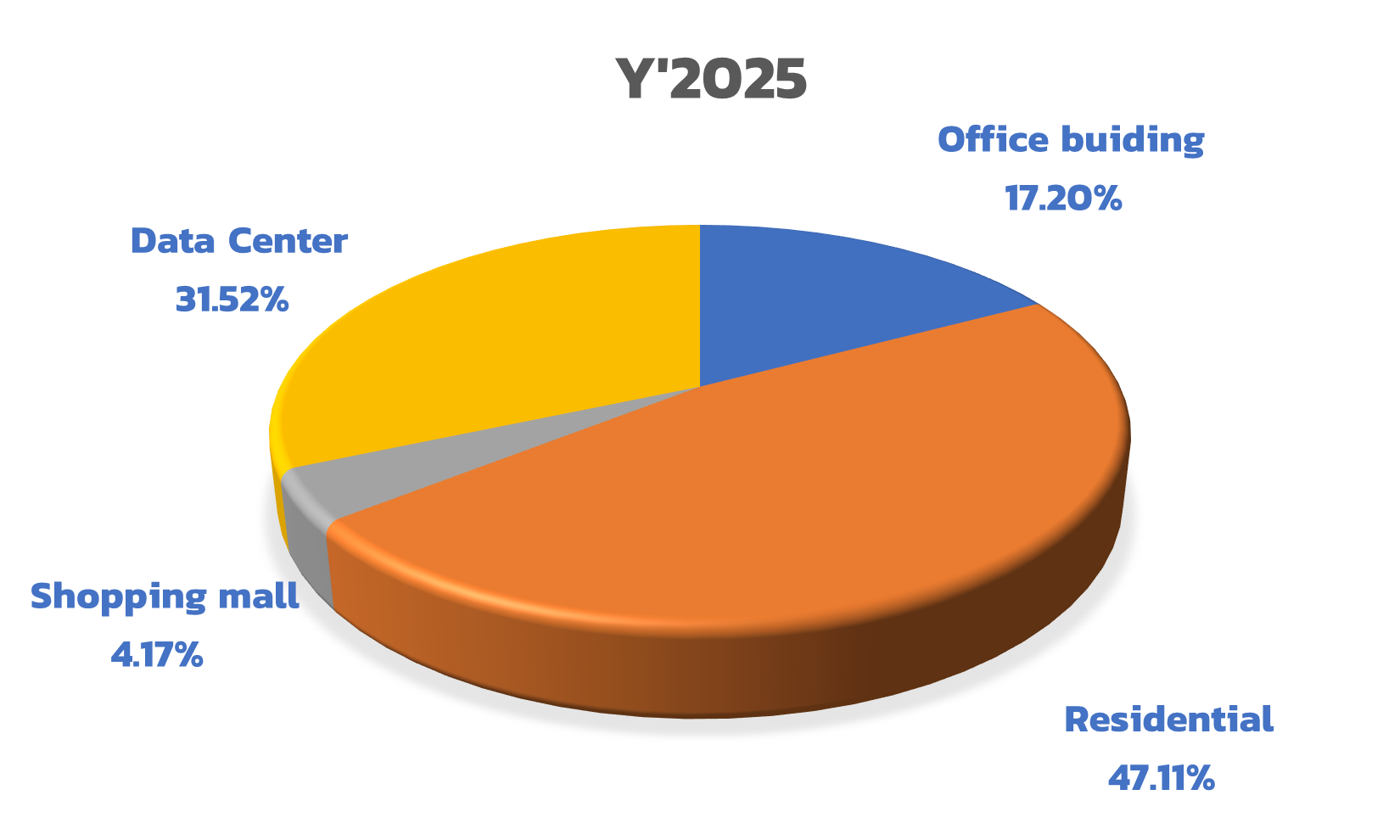
Year 2025, the Company and its subsidiaries reported service income of 805.60 million Baht, representing an increase of 178.03 million Baht or 28.37% compared to 2024. This performance exceeded the revenue target of 650 million Baht by 23.94%. The growth was primarily driven by the expansion in Data Center projects, coupled with the continuity of long-term contracts in office building and residential projects. The revenue breakdown by segment is as follows:
Office Building Projects amounted to 138.56 million Baht, accounting for 17.20% of total revenue. This reflects a decrease of 49.49 million Baht or 26.32% from 2024.
Residential building projects amounted to 379.52 million Baht, representing 47.11% of total revenue, an increase from 2024 amount 122.22 million Baht or accounting for 47.50%.
Project group of Data Center amounted to 253.91 million Baht, representing 31.52% of total revenue, an increase from 2024 amount 253.91 million Baht or accounting for 17.20%.
Project group of Shopping Mall amounted to 33.61 million Baht, representing 4.17% of total revenue, a decrease from 2024 amount 148.61 million Baht or accounting for 81.56%.
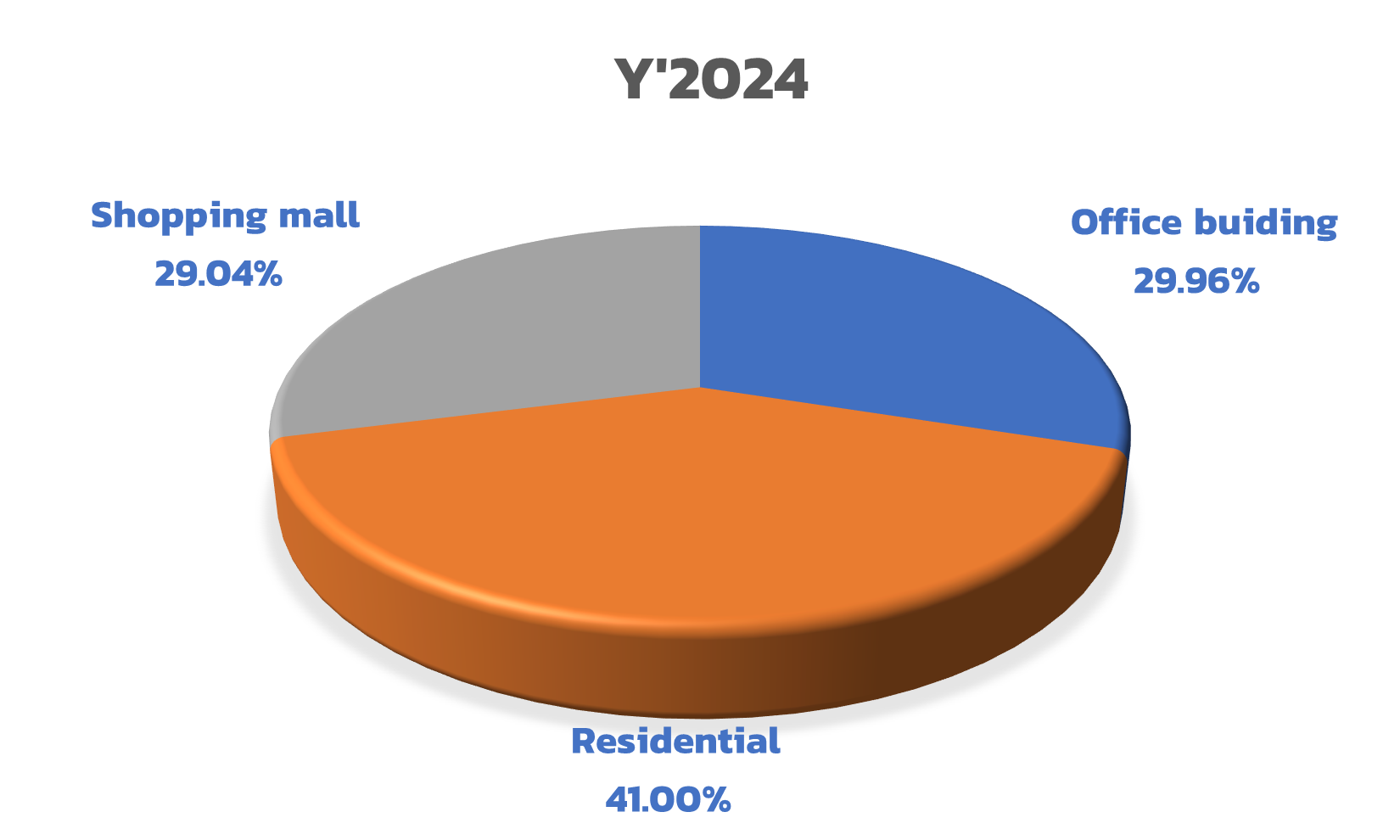
Year 2024, the Company had revenue from services amounting to 627.57 million Baht, an increase from 2023 Amount 229.02 million Baht or 57.46% in line with the set revenue target. 600 million Baht in 2024 which exceeded the target by 4.60% of the target resulted from revenue growth in office building and residential building projects, with the proportion of revenue in each segment as follows:
Office Building Projects amounted to 188.05 million Baht representing 29.96% of total revenue, an increase from 2023 amount 55.52 million Baht or accounting for 41.89%
Residential building projects amounted to 257.30 million Baht, representing 41% of total revenue, an increase from 2023 amount 251.86 million Baht or accounting for 4,629.78%
Project group of Shopping Mall amount 182.22 million Baht, representing 29.04% of total revenue, a decrease from 2023 amount 78.36 million Baht or accounting for 30.07%
Financial income
Financial income for the year 2023 – 2025 amounted to 1.08 million Baht, 1.50 million Baht and 1.60 million Baht respectively, The breakdown of these changes is as follows:
Year 2025 had financial income of 1.60 million Baht consisting of interest income from financial institutions amounting to 1.47 million Baht and interest from overdue trade receivables amounting to 0.13 million Baht, an increase from 2024 amount 0.10 million Baht or accounting for 6.67%.
Year 2024 had financial income of 1.50 million Baht consisting of interest income from financial institutions amounting to 1.42 million Baht and interest from overdue trade receivables amounting to 0.08 million Baht, an increase from 2023 amount 0.42 million Baht or accounting for 38.89%
The company prioritizes liquidity and manages excess cash for maximum efficiency, with funds deposited in financial institutions at an interest rate of 0.25 – 1.88 per annum, representing an increase in interest income during the year, and another portion from short-term investments to achieve higher returns and tax benefits, while maintaining liquidity and convertibility to cash within a short period.
Other income
Other income in the year 2023 – 2025 amounted to 3.01 million Baht, 4.20 million Baht and 4.05 million Baht respectively, The breakdown of these changes is as follows:
Year 2025 had other income of 4.05 million Baht, a decrease from 2024 amount 0.15 million Baht or 3.57%, did not significantly change from the previous year. Other income primarily consisted of revenue from the sale of scrap materials and revenue from the reversal of expense provisions upon the termination of obligations, among others.
Year 2024 had other income of 4.20 million Baht, an increase from 2023 amount 1.19 million Baht or 39.53%. The main reasons were due to the increase in revenue from the sale of scrap materials and revenue from the reversal of compensation. The portion of resigned employees, recognized as other income due to the termination of benefit payment obligations, etc.
Cost of services
Year 2025 had cost of services amounting to 667.38 million Baht, an increase from 2024 amount 147.04 million Baht or accounting for 28.26%
Year 2024 had cost of services amounting to 520.34 million Baht, an increase from 2023 amount 201.06 million Baht or accounting for 62.97%
The increase in cost of services varied with the increase in revenue, stemming from increased usage volume and higher cost prices. The majority of service cost items were from
Materials and Equipment are the primary components in providing mechanical, electrical, and plumbing (MEP) engineering installation services. These are categorized by system, including electrical, air conditioning, sanitary, fire protection, and general materials. Consequently, material price volatility is a significant factor directly impacting project costs. To mitigate this risk, the Company and its subsidiaries have established guidelines starting from the bidding process, cost estimation, and procurement. This involves monitoring price movements and incorporating buffers for potential fluctuations to ensure competitive and appropriate pricing. Furthermore, material usage is strictly controlled to align with engineering designs and specifications.
Labor Costs are essential operating expenses for the installation of MEP systems to ensure successful and timely project delivery. Key factors affecting labor costs include minimum wage hikes, labor shortages, and labor quality. The Company and its subsidiaries maintain a policy of outsourcing labor, primarily for skilled workers in electrical, plumbing, and sanitary systems, to optimize cost management. This approach offers greater cost efficiency compared to maintaining internal units, which incur fixed overheads. Therefore, the subcontractor selection process is critical to ensuring high-quality workmanship. Selection criteria are based on experience, past performance, punctuality, and labor readiness. To diversify risk and reduce over-dependence on any single party, the Company typically engages an average of 6–10 subcontractors per project, or more, depending on the project's scale.
Cost of services incurred each year are detailed as follows:
Cost of services | Year 2023 | Year 2024 | Year 2025 | Change 2024 - 2023 | Change 2025 - 2024 | ||
million Baht | million Baht | million Baht | million Baht | % | million Baht | % | |
Cost of materials | 216.18 | 320.05 | 329.44 | 103.87 | 48.05 | 9.39 | 2.93 |
Subcontractor labor costs | 46.53 | 120.42 | 219.54 | 73.89 | 158.80 | 99.12 | 82.31 |
Salaries and employee-related expenses | 41.96 | 66.53 | 76.41 | 24.57 | 58.56 | 9.88 | 14.85 |
Utilities and common area expenses 1 | 2.73 | 3.05 | 25.28 | 0.32 | 11.72 | 22.23 | 728.85 |
Office and equipment rental expenses | 1.66 | 1.57 | 3.04 | (0.09) | (5.42) | 1.47 | 93.63 |
Depreciation and amortization | 0.21 | 0.41 | 0.73 | 0.20 | 95.24 | 0.32 | 78.05 |
Estimated performance guarantee | 6.71 | 3.64 | 4.72 | (3.07) | (45.75) | 1.08 | 29.67 |
Other cost of services 2 | 3.30 | 4.66 | 8.22 | 1.36 | 41.21 | 3.56 | 76.39 |
Total | 319.28 | 520.34 | 667.38 | 201.06 | 62.97 | 147.05 | 28.26 |
Note: 1 Utilities and Common Area consist of Expenses Comprising water supply, electricity, telephone, cleaning services, security services, freight elevator services, and common area service fees shared with other subcontractors, etc. 2 Other Service Costs consist of Comprising transportation expenses, professional fees, consumables, repair and maintenance costs, printing expenses, stamp duties, and insurance premiums, etc. | |||||||
Gross profit
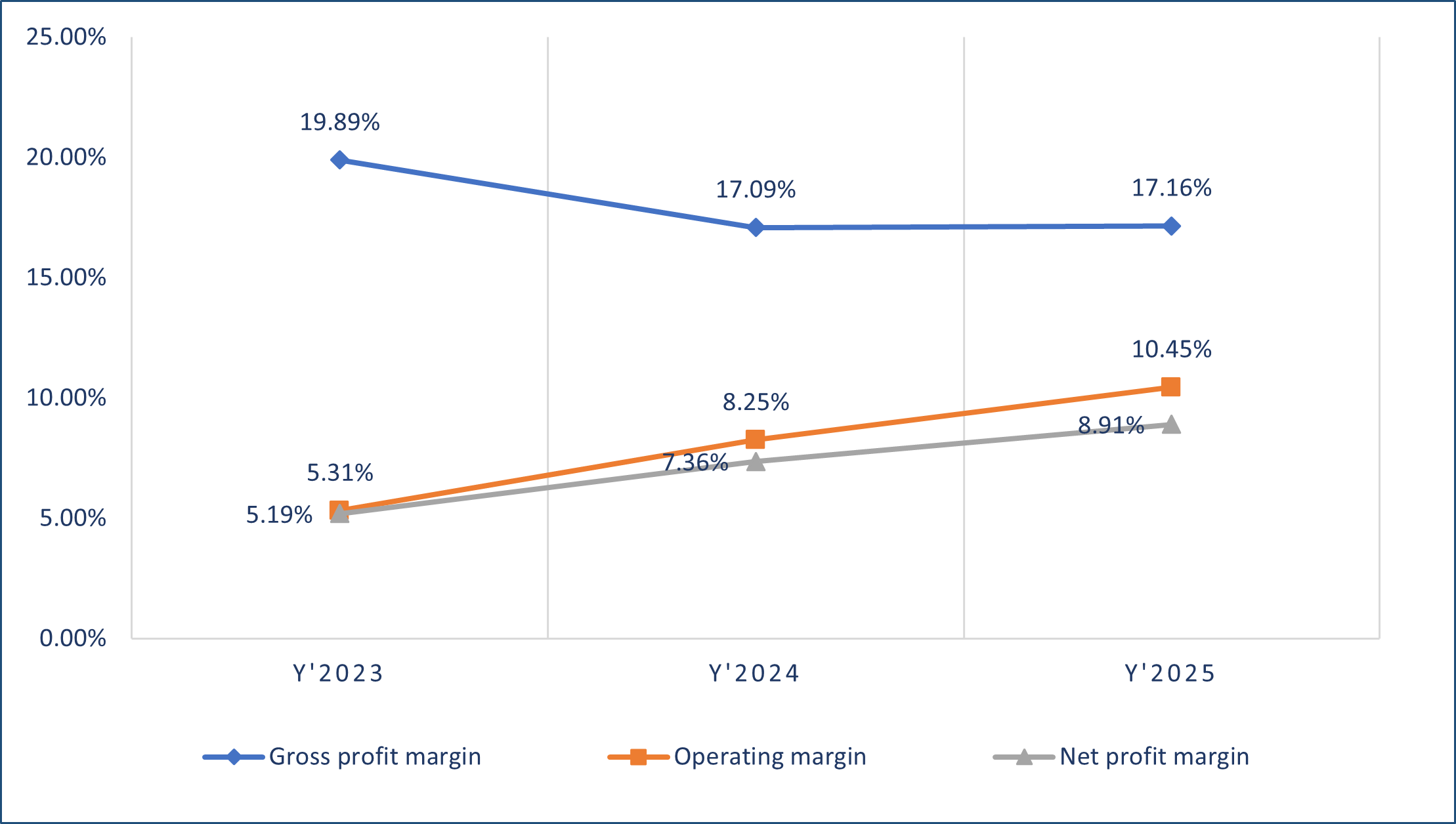
Year 2025, the Company and its subsidiaries reported a gross profit of 138.22 million Baht, representing a gross profit margin of 17.16%. This gross profit margin was not significantly different from 2024, but the value of profit increased in proportion to the increase in revenue. The gross profit in 2025 increased by 30.99 million Baht or 28.90% from 2024, due to overall revenue growth, particularly in high-profit project segments such as office building projects and Data Center projects.
Year 2024, the Company and its subsidiaries reported a gross profit of Baht 107.23 million, representing a gross profit margin of 17.09%. The gross profit value increased by Baht 27.96 million or 35.27% from 2023. However, the gross profit margin experienced a decline. This was primarily because office building and residential projects are long-term contracts with lower profit margins compared to department store projects, which are shorter-term. Furthermore, fluctuations in material and labor costs over different periods led to higher project costs and narrowed profit margins. Nevertheless, due to the high contract value of these long-term projects, they significantly contributed to the overall growth of both revenue and gross profit value.
Gross profit margin for each project is influenced by competition, project duration, and cost of services. Therefore, the company emphasizes cost management from project acquisition, cost budgeting, procurement planning, and contractor engagement, through to timely and quality project delivery.
Administrative expenses
Year 2025, administrative expenses amount to 58.11 million Baht, a decrease from 2024 amounting to 1.55 million Baht or 2.60%
Year 2024, administrative expenses amount to 59.66 million Baht, a decrease from 2023 amounting to 1.43 million Baht or 2.34%
The main reason was a decrease in employee-related expenses allocated to cost of services, due to revenue growth and continuous work throughout the year. 2024 - 2025 demonstrating efficient personnel management.
Administrative expenses incurred each year are detailed as follows:
Administrative expenses | Year 2023 | Year 2024 | Year 2025 | Change 2024 - 2023 | Change 2025 - 2024 | ||
million Baht | million Baht | million Baht | million Baht | % | million Baht | % | |
Salaries and employee-related expenses | 43.68 | 41.90 | 41.13 | (1.78) | 8.98 | (0.77) | (1.84) |
Audit fees | 1.67 | 1.82 | 1.63 | 0.15 | (12.84) | (0.19) | (10.44) |
Other professional fees 1 | 1.48 | 1.29 | 0.90 | (0.19) | (12.84) | (0.39) | (30.23) |
Utilities expenses | 0.73 | 0.65 | 0.57 | (0.08) | (10.96) | (0.08) | (12.31) |
Depreciation and amortization | 7.17 | 6.98 | 6.59 | (0.19) | (2.65) | (0.39) | (5.59) |
Other expenses 2 | 6.36 | 7.02 | 7.29 | 0.66 | 10.38 | 0.27 | 3.85 |
Total | 61.09 | 59.66 | 58.11 | (1.43) | (2.34) | (1.55) | (2.60) |
Note: 1 Other Professional Fees include internal audit fees, ISO audit fees, and legal service fees, among others. 2 Other expenses include directors' remuneration, meeting expenses, safety costs, maintenance expenses, and other fees and taxes, among others. | |||||||
Reversal of expected credit losses
Expected credit losses resulted from the company's provision for doubtful accounts of receivables, in accordance with Financial Reporting Standard No. 9 regarding financial instruments, reviewed at each reporting period end to reflect changes in credit risk initially recognized for financial instruments, calculated using a simplified approach. (Simplified approach) in conjunction with management's judgment, using a historical credit loss provision matrix, adjusted for specific debtor factors, risks, and probability of collection, as well as future economic forecasts.
Year 2023, the Company recognized an expected credit loss (ECL) on retention receivables amounting to 0.36 million Baht. Subsequently, in 2024–2025, the Company recorded a reversal of expected credit loss in the amounts of 0.22 million Baht and 0.41 million Baht, respectively. These reversals resulted from the successful collection of payments from trade receivables for which provisions had been previously established.
Finance costs
The Company and its subsidiaries have no outstanding debt obligations to related parties or financial institutions. The finance costs reported in the financial statements are derived from:
Fees related to the increase of a combined credit line for business liquidity from a financial institution. This initiative aims to support business expansion and diversify credit risk by reducing over-reliance on any single financial institution.
Interest expenses arising from the adoption of Thai Financial Reporting Standard No. 16 (TFRS 16) "Leases" for lease agreements with a term exceeding 12 months, excluding short-term leases (12 months or less) and leases of low-value underlying assets. The Company recognizes right-of-use assets and lease liabilities at the present value of lease payments, discounted using the incremental borrowing rate. These primarily consist of office equipment leases with terms of 2–5 years, featuring fixed lease payments throughout the period under standard commercial terms.
Net profit
Year 2025, the Company and its subsidiaries reported a net profit of 72.26 million Baht, representing a net profit margin of 8.91%. This reflects an improvement in the profit margin from 2024, with a value increase of 25.63 million Baht or 54.96%. This growth signifies enhanced earnings quality, driven by effective cost management and administrative expense control. Furthermore, the robust growth in both revenue and profit from subsidiaries compared to 2024 significantly contributed to the overall increase in net profit.
Year 2024, the Company and its subsidiaries achieved a net profit of 46.63 million Baht, equivalent to a net profit margin of 7.36%. This marks an increase from 2023, with the profit value rising by 25.72 million Baht or 123%. The growth was primarily driven by revenue expansion in office building, department store, and residential projects. Combined with the efficient management of both cost of services and administrative expenses, these factors resulted in a substantial increase in net profit.
Analysis of financial position
Statement of financial position | Year 2023 | Year 2024 | Year 2025 | Change 2024 - 2023 | Change 2025 - 2024 | ||
million Baht | million Baht | million Baht | million Baht | % | million Baht | % | |
Assets | |||||||
Current assets: | |||||||
Cash and cash equivalents | 118.54 | 162.20 | 294.56 | 43.66 | 36.83 | 132.36 | 81.60 |
Short-term investments | 120.94 | 149.17 | 32.94 | 28.23 | 23.34 | (116.23) | (77.92) |
Trade and other receivables | 93.40 | 103.36 | 66.15 | 9.96 | 10.66 | (37.21) | (36.00) |
Unbilled completed work | 9.82 | 31.35 | 26.05 | 21.53 | 219.25 | (5.30) | (16.91) |
Inventories | 11.11 | 39.13 | 16.64 | 28.02 | 252.21 | (22.49) | (57.48) |
Other current assets | 5.27 | 4.85 | 4.29 | (0.42) | (7.97) | (0.56) | (11.55) |
Non-current assets: | |||||||
Restricted bank deposits | 5.00 | 5.00 | 19.70 | - | - | 14.70 | 294.00 |
Property, plant and equipment | 141.57 | 137.25 | 133.38 | (4.32) | (3.05) | (3.87) | (2.82) |
Right-of-use assets | 0.06 | 0.01 | - | (0.05) | (83.33) | (0.01) | (100.00) |
Intangible assets | 0.76 | 0.72 | 1.40 | (0.04) | (5.26) | 0.68 | 94.44 |
Retention receivables | 16.98 | 36.84 | 52.19 | 19.86 | 116.96 | 15.35 | 41.67 |
Deferred tax assets | 5.00 | 7.12 | 10.64 | 2.12 | 42.40 | 3.52 | 49.44 |
Other non-current assets | 22.10 | 6.01 | 3.56 | (16.09) | (72.81) | (2.45) | (40.77) |
Total assets | 550.55 | 683.01 | 661.50 | 132.46 | 24.06 | (21.51) | (3.15) |
Liabilities and equity | |||||||
Current liabilities | |||||||
Trade and other payables | 43.60 | 116.21 | 65.13 | 72.61 | 166.54 | (51.08) | (43.95) |
Current portion of liabilities | 0.05 | 0.02 | - | (0.03) | (60.00) | (0.02) | (100.00) |
Advances received | 20.47 | 32.52 | 1.84 | 12.05 | 58.87 | (30.68) | (94.43) |
Corporate income tax payable | - | - | 0.24 | - | - | 0.24 | 100.00 |
Provision for employee benefits | - | 0.35 | - | 0.35 | 100.00 | (0.35) | (100.00) |
Provision for loss From cost exceed related consideration | - | - | 24.18 | - | - | 24.18 | 100.00 |
Other current liabilities | 12.05 | 14.45 | 9.48 | 2.40 | 19.92 | (4.97) | (34.39) |
Non-current liabilities: | |||||||
Lease liabilities | 0.02 | - | - | (0.02) | (100.00) | - | - |
Provisions for employee benefit | 6.62 | 7.66 | 10.26 | 1.04 | 15.71 | 2.60 | 33.94 |
Provisions | 9.35 | 9.25 | 11.99 | (0.10) | (1.07) | 2.74 | 29.62 |
Total liabilities | 92.16 | 180.46 | 123.12 | 88.30 | 95.81 | (57.34) | (31.77) |
Equity: | |||||||
Ordinary shares | 200.00 | 222.22 | 222.22 | 22.22 | 11.11 | - | - |
Premium on share capital | 193.14 | 193.14 | 193.14 | - | - | - | - |
Retained earnings | |||||||
Appropriated-Legal reserve | 19.05 | 22.22 | 22.22 | 3.17 | - | - | |
Unappropriated | 46.20 | 64.97 | 100.80 | 18.77 | 40.63 | 35.83 | 55.15 |
Total shareholders' equity | 458.39 | 502.55 | 538.38 | 44.15 | 9.63 | 35.83 | 7.13 |
Total liabilities and Equity | 550.55 | 683.01 | 661.50 | 134.46 | 24.06 | (21.51) | (3.15) |
Assets
As of 31 December 2023 – 2025 the Company and its subsidiaries had total assets of 550.55 million Baht, 683.01 million Baht and 661.50 million Baht, respectively. In 2025 had total assets decreased from 2024 amount 21.51 million Baht or 3.15%.
Cash and cash equivalents
The Company and its subsidiaries had cash and cash equivalents as of 31 December 2025 amount 294.56 million Baht, an increase from 31 December 2024 amount 132.36 million Baht or 81.60% resulted from cash flows from operating activities, primarily from the collection of service fees, and cash flows from investing activities, from the proceeds of investment disposals.
Short-term investments
The Company and its subsidiaries had short-term investments as of 31 December 2025 amount 32.94 million Baht, a decrease from as of 31 December 2024 amount 116.23 million Baht or 77.92% resulted from investments in short-term investments during the year totaling 30.66 million Baht, sold investments amounting to 151.47 million Baht and resulted from fair value adjustments of 4.58 million Baht.
Trade and other receivables
The Company and its subsidiaries had trade and other receivables as of 31 December 2025 amounting to 66.15 million Baht, a decrease from as of 31 December 202 7 amount 37.21 million Baht or 36.00% resulted from projects being gradually delivered, with most installments billed and payments received during the year from debtors according to their due payment cycles, which have credit terms of approximately 30-45 days, with remaining receivables resulting from collections at year-end 2025 the majority of which consists of receivables not yet due.
Unbilled completed work
Contract assets represent the value of work completed and recognized as revenue based on the stage of completion, for which the Company has not yet issued invoices to the employers. These assets comprise material costs, subcontractor labor costs, personnel-related expenses, and various overheads, including project operating profits, less the amounts already billed to customers. These amounts are reclassified as trade receivables once the billing is formally issued to the customers. As of December 31, 2025, contract assets amounted to 26.05 million Baht, a decrease of 5.30 million Baht or 16.91% from December 31, 2024. This decline was primarily due to the gradual handover of projects and the issuance of billings throughout the year.
Inventories
Inventories comprise materials and equipment used for mechanical, electrical, and plumbing (MEP) engineering installation services. These are stated at the lower of cost or net realizable value. As of December 31, 2025, the Company and its subsidiaries held inventories amounting to 16.64 million Baht, representing a decrease of 22.49 million Baht or 57.48% from December 31, 2024. This decline was primarily due to the gradual handover of most projects, leading to a reduction in new procurement. The inventories remaining at year-end are designated for ongoing projects and will be progressively requisitioned for the installation of MEP engineering systems.
Restricted bank deposits
As of December 31, 2025, the Company and its subsidiaries held bank deposits pledged as collateral amounting to 19.70 million Baht, an increase of 14.70 million Baht or 294.00% from December 31, 2024. This increase resulted from the requirement to place bank deposits as security, equivalent to 30% of the utilized credit facility.
Property, plant and equipment
Property, plant and equipment are assets used in the operations of the company and its subsidiaries, presented at cost less accumulated depreciation. These include land, office buildings, vehicles, office equipment, and tools, among others. As of 31 December 2025 amounted to 133.38 million Baht, a decrease from 2024 amount 3.87 million Baht or 2.82%, resulted from the acquisition of vehicles, tools, and equipment for the installation of building engineering systems, and the recognition of depreciation for buildings and equipment using the straight-line method over their useful lives.
Retention receivables
Retention receivables arise from customers withholding a portion of the service value, typically at a rate of 5%–15% of each progressive billing, until the total withheld reaches 5% of the total contract value. The Company is entitled to the return of these retentions upon project completion and fulfillment of all contractual obligations. The standard warranty period for such works generally ranges from 1 to 2 years. As of December 31, 2025, retention receivables amounted to 52.19 million Baht, an increase of 15.35 million Baht or 41.67% from 2024. This increase was driven by a higher volume of work billed during 2025, resulting in additional retentions withheld in accordance with the specific terms and conditions of each project contract.
Liabilities
As of 31 December 2023 – 2025 The company and its subsidiaries had total liabilities of 92.16 million Baht, 180.46 million Baht and 123.12 million Baht, respectively. In 2025 had total liabilities decreased from 2024 amount 57.34 million Baht or 31.77%. The main reasons for the significant changes were due to
Trade and other payables
Trade and other payables as of 31 December 2025 amounted to 65.13 million Baht, primarily consisting of trade payables for construction materials, subcontractor payables, accrued expenses and returns, a decrease from 31 December 2024 amount 51.08 million Baht or 43.95%. This decrease was primarily due to a reduction in procurement orders, as the majority of projects reached their gradual handover stages. Additionally, the Company continued to settle its obligations according to the standard payment cycles. The Company typically receives credit terms of 30–60 days from suppliers and 5–10 days from subcontractors. For the fiscal year 2025, the Company’s average payment period stood at 50 days.
Advances received
Advances received or assets arising from contracts resulted from billing the client at a rate of 5 – 10 of the contract value and will be gradually deducted from installments collected until the full value of the advance payment is recovered. This also arises from recognizing revenue based on the percentage of completion exceeding the amount billed to the client. Advance payments will be gradually amortized upon delivery of work in each installment. As of 31 December 2025 advance payments received amount to 1.84 million Baht, a decrease from as of 31 December 2024 Amount 30.68 million Baht or 94.43%. This decrease was primarily due to the progressive handover of projects. As the majority of project milestones were billed, the employers have fully offset the advances against the work completed. Consequently, this has led to a reduction in the advance received from customers balance.
Provision for loss From cost exceed related consideration
The Company recognized a provision for estimated costs in excess of consideration, primarily within the residential project group, where total estimated costs are expected to exceed the net realizable value. This situation arose from project delays beyond the contractual period, caused by the failure of the main construction contractors to hand over the work areas on schedule. Consequently, the Company, as the MEP (Mechanical, Electrical, and Plumbing) engineering contractor, was unable to proceed with the installation within the agreed timeframe. The Company has established this provision in accordance with Thai Financial Reporting Standard No. 15 (TFRS 15) "Revenue from Contracts with Customers" and the principle of prudence. However, management assesses that these delays did not result from any fault of the Company. Therefore, the Company is currently in the process of negotiating cost recovery with the counterparty and will determine further appropriate actions.
Provision
Provision for liabilities represents the estimated post-delivery warranty expenses that the company is expected to incur for repair or rectification services as stipulated in contracts. Most warranty periods are 1-2 year. As of 31 December 2025 had provisions for liabilities amounting to 11.99 million Baht, an increase from 31 December 2024 amount 2.74 million Baht or 29.62%. This resulted from an increase in provisions by 6.34 million Baht recognized during the period, from projects being gradually delivered and a decrease in provisions of 3.60 million Baht, resulting from actual expenses incurred and the reversal of remaining warranty provisions for projects whose warranty periods have ended.
Shareholders' equity
As of 31 December 2023 – 2025, the Company and its subsidiaries had shareholders' equity of 458.39 million Baht and 538.38 million Baht, respectively. In 2025 had shareholders' equity increased from 2024 amount 35.83 million Baht or 7.13%. The key drivers of these significant changes include:
dividend payment for the year 2024 as per the resolution approved at the annual General Meeting of Shareholders on 2025 amount 35.55 million Baht.
2025 in the consolidated financial statements 71.38 million Baht.
Liquidity & Capital Adequacy
The Company and its subsidiaries maintain a relatively high liquidity ratio, with no debt obligations or interest payments to financial institutions, indicating a high debt repayment capability. They possess a strong and sufficient capital structure to ensure continuous and sustainable operations and to further expand business growth. The financial ratios demonstrating liquidity and capital adequacy are as follows:
Liquidity and Capital Adequacy | Year 2023 | Year 2024 | Year 2025 | |
Current ratio | Times | 4.71 | 3.00 | 4.37 |
Quick ratio | Times | 4.37 | 2.53 | 3.90 |
Cash flow liquidity ratio | Times | 0.33 | 0.62 | 0.91 |
Debt-to-equity ratio | Times | 0.20 | 0.36 | 0.23 |
Cash flow is a crucial factor for business operations and continuous sustainability. From 2023 to 2025, the Company and its subsidiaries have consistently maintained positive cash flow, demonstrating an increase in cash flow each year, as follows:
Cash Flow | Year 2023 | Year 2024 | Year 2025 |
Cash flow from operating activities | 26.93 | 74.53 | 52.00 |
Cash flow from (used in) investing activities | (0.90) | (28.35) | 116.66 |
Cash used in financing activities | (2.27) | (2.52) | (36.30) |
Net increase in cash | 23.76 | 43.66 | 132.36 |
Asset Management Capability
The company and its subsidiaries efficiently manage assets, demonstrating strong asset growth, effective cash flow management, appropriate accounts receivable control, and systematic management of each asset type. The financial ratios indicating asset management efficiency are as follows:
Asset Management Efficiency | Year 2023 Year 2024 | Year 2025 | ||
Accounts Receivable Turnover Ratio | times | 3.64 | 6.08 | 9.51 |
Average Collection Period | day | 100.22 | 60.07 | 38.40 |
Inventory Turnover Ratio | times | 24.01 | 20.72 | 23.93 |
Average Days to Sell Inventory | days | 15.2 | 17.62 | 15.25 |
Asset Turnover Ratio | times | 0.74 | 1.03 | 1.21 |
Return on Assets | percent | 4.61 | 9.23 | 13.28 |
Return on Fixed Assets | percent | 19.54 | 38.75 | 58.81 |
Debt Obligations & Off-Balance-Sheet Management
Contingent commitments and liabilities
The Company and its subsidiaries have the following commitments and contingent liabilities:
1. Letters of guarantee as of December 31, 2025, have obligations arising from financial institutions issuing bank guarantees to guarantee electricity usage and contractual performance, totaling 140.67 million Baht.
2. Contractual commitments payable as of December 31, 2025, comprising:
- Lease contracts at a monthly rate of 0.08 million Baht.
- Security service contracts at a monthly rate of 0.06 million Baht.
- Cleaning service contracts at a monthly rate of 0.03 million Baht.
- Contractor engagement contracts totaling 11.48 million Baht.
- Material and equipment purchase contracts totaling 10.40 million Baht.
- Other service contracts totaling 0.50 million Baht.
3. Lawsuit. On September 11, 2024, the Company was sued by a creditor for damages due to breach of a sales contract, with a claim amount of 0.72 million Baht plus interest. Currently, the case is under consideration by the Court of First Instance. Management expects that no damages will be incurred from this lawsuit.
Debt Securities with Financial Ratio Requirements
Debt Securities with Financial Ratio Requirements Issued?
No
Factors That May Affect Financial Condition
Factors or Incidents That May Materially Affect Financial Condition
An analysis by SCB EIC reveals that the value of the construction industry in 2026 is projected to remain stable at 1.41 trillion Baht, with the breakdown of public and private sector construction values as follows:
The value of public sector construction in 2026 is projected to expand by +1% YOY, reaching 860 billion Baht. This growth faces pressure from the budget expenditure framework for fiscal year 2026, with investment budget allocations decreasing by 5% from fiscal year 2026, coupled with political uncertainties. Nevertheless, ongoing mega-projects are progressing, and new mega-projects are expected to be tendered in 2026.
The value of private sector construction in 2026 is projected to continue contracting to 551 billion Baht (-1% YOY). Residential building construction is expected to continuously contract by -2% YOY due to the shrinking housing market, while commercial real estate construction is projected to remain stable.
The aforementioned economic trends in the construction industry directly impact the company and its subsidiaries as building engineering system contractors, particularly in private sector construction, which is the company's primary source of revenue. Factors that may affect future financial status and operations are as follows:
1. Construction Costs Remain High
- Construction Materials: Although construction material prices are projected to decrease in 2026, they remain high compared to historical prices (before 2022). However, close monitoring is required for increased steel imports from China into Thailand due to US tariff policies, as well as fluctuations in energy prices.
- Labor: The number of laborers is projected to decrease from 2025, potentially leading to upward pressure on wages. This also includes the impact of the Thai-Cambodian border conflict. It is expected that laborers will not return to Cambodia as wages in Thailand remain significantly higher. However, border skirmishes may affect cross-border/seasonal labor groups.
2. Impact of Earthquake Events
- The condominium market is affected, with slow recovery in condominium construction, leading to lost revenue opportunities for construction contractors. Additionally, changing condominium purchasing behaviors compel real estate developers to highlight the credibility of construction contractors as a key selling point.
- Construction project owners are becoming more stringent regarding the quality and standards of construction materials, as well as construction procedures.
- Increased regulatory stringency, particularly measures implemented after the earthquake, to encourage construction contractors to prioritize thoroughness and strict safety standards. Examples include amendments to ministerial regulations regarding blacklisting, grade adjustments and reductions, and the revocation of licenses for negligent contractors whose actions result in injuries and fatalities.
3. Role of Chinese Contractors
Chinese construction contractors are increasingly likely to enter into joint ventures with Thai contractors. Their entry, often in the form of using Thai construction contractors as nominees, exposes them to risks, including:
- Price competition in bidding for projects.
- Lack of safety in construction.
- Issues with project delivery.
- Impacts related businesses in the supply chain by increasing the use of construction materials from China.
4. Oversupply in the Real Estate Sector
In the residential sector, there is a rising risk of unsold units, while the commercial real estate sector faces an oversupply of office and retail rental spaces. This situation may lead to a slowdown in the construction of unviable projects.
5. Low Productivity in the Construction Sector
- Over the past 10 years, labor productivity in the Thai construction sector has grown at a CAGR of 2.7%, which is lower than other service sectors.
- Widely used technologies include design and construction software, prefabricated construction technology, intermediary platforms, as well as environmentally friendly construction machinery and equipment.
- Technologies that will significantly enhance productivity include Building Information Modeling (BIM), which is a virtual model of a building that helps manage projects by integrating data and processes at every stage, from design, drafting, structural calculation, cost estimation, procurement, to management.
6. Pressure to Reduce Emissions
The demand for structures aligning with sustainability trends pressures construction contractors to enhance their capabilities to meet the requirements of real estate developers or construction project owners.
Adjusting strategies for construction contractors to ensure continuous and sustainable business operations.
1. Increase Revenue Opportunities
- Develop capabilities and collaborate with partners to bid for a wider range of projects.
- Public-private partnerships.
- Exercise caution when participating in price-competitive bidding.
- Increase opportunities to secure subcontracting work from large construction contractors for ongoing infrastructure projects and major private sector construction.
2. Emphasize Backlog Management
- Adjust the proportion of bids for public and private sector construction projects appropriately.
- Complete construction according to the plan and deliver work as per the contract to ensure timely payment of installments.
3. Construction Cost Control
- Partner with a diverse range of construction material suppliers and manufacturers to provide options and reduce reliance on any single entity.
- Enter into advance purchase agreements for construction materials, aligning with usage requirements.
- Mitigate risks of labor shortages and rising labor costs by monitoring labor situations, planning labor utilization in line with construction schedules, and investing in construction technology to replace manual labor.
4. Utilizing Technology to Enhance Productivity
- Invest in adopting technology to replace labor, reduce material waste, and minimize errors from incorrect construction designs.
- Partner with foreign construction contractors who possess technological expertise to facilitate knowledge transfer.
- Develop personnel to support the adoption of construction technology.
5. Building Credibility
- Implement rigorous safety upgrades to ensure construction processes strictly adhere to 'Zero Accident' standards, while utilizing only high-quality and certified materials.
- Partner with reputable and highly experienced foreign construction contractors who also possess expertise in construction technology capable of mitigating various disasters.
6. Reducing Emissions
- Partner with environmentally friendly construction material suppliers and manufacturers.
- Invest in adopting environmentally friendly technologies.
- Increase energy efficiency in both construction sites and offices.